
Floyd County Warrant Checks
A Floyd County warrant check begins at Indiana MyCase. Run a party search by name, case number, or attorney. Narrow by county and case status as needed. The portal can surface public events from Floyd Circuit Court and Superior Courts 1, 2, and 3. Treat it as a lead rather than a live warrant roster, since the site's own notices say the online display is not the official court record. Bring the full legal name, a date of birth when an official asks, and any case or ticket number. Close names cause false matches. When the question is personal and arrest is possible, a lawyer can help you plan safe contact with the court.
- Search MyCase for public Floyd County cases and read the docket, not just the result heading.
- Call the Floyd County Clerk at 812-948-5411 to confirm the issuing court, current file, and next court-directed step.
- Contact the named Circuit or Superior Court when the Clerk directs the inquiry there.
- For non-exempt Sheriff records, ask Records Requests at 812-542-1790 about the county request process.
- Use jail AIS at 812-948-5406 only for custody or bond logistics, and speak with counsel before surrender or bond decisions.
MyCase Is Not a Warrant Roster
The state search tips lay out the fields behind a Floyd County court search. A party search takes a name and filters by county, case type, status, and date. Wildcards help with tricky spellings, but broad searches can hit the result limit. A case number is the sharper tool. Current Floyd Odyssey court codes are 22C01, 22D01, 22D02, and 22D03.
| Search field | Best use | Limit |
|---|---|---|
| Party name | Finding a possible public case | Similar names need identity checks |
| Case number | Opening a known Floyd court file | Older codes may differ |
| County and status | Narrowing the result set | Status is not live warrant certification |
| Date range | Focusing on a known period | A narrow range can omit the case |
The official MyCase landing screen draws the line between a useful lead and a certified Floyd County warrant record.
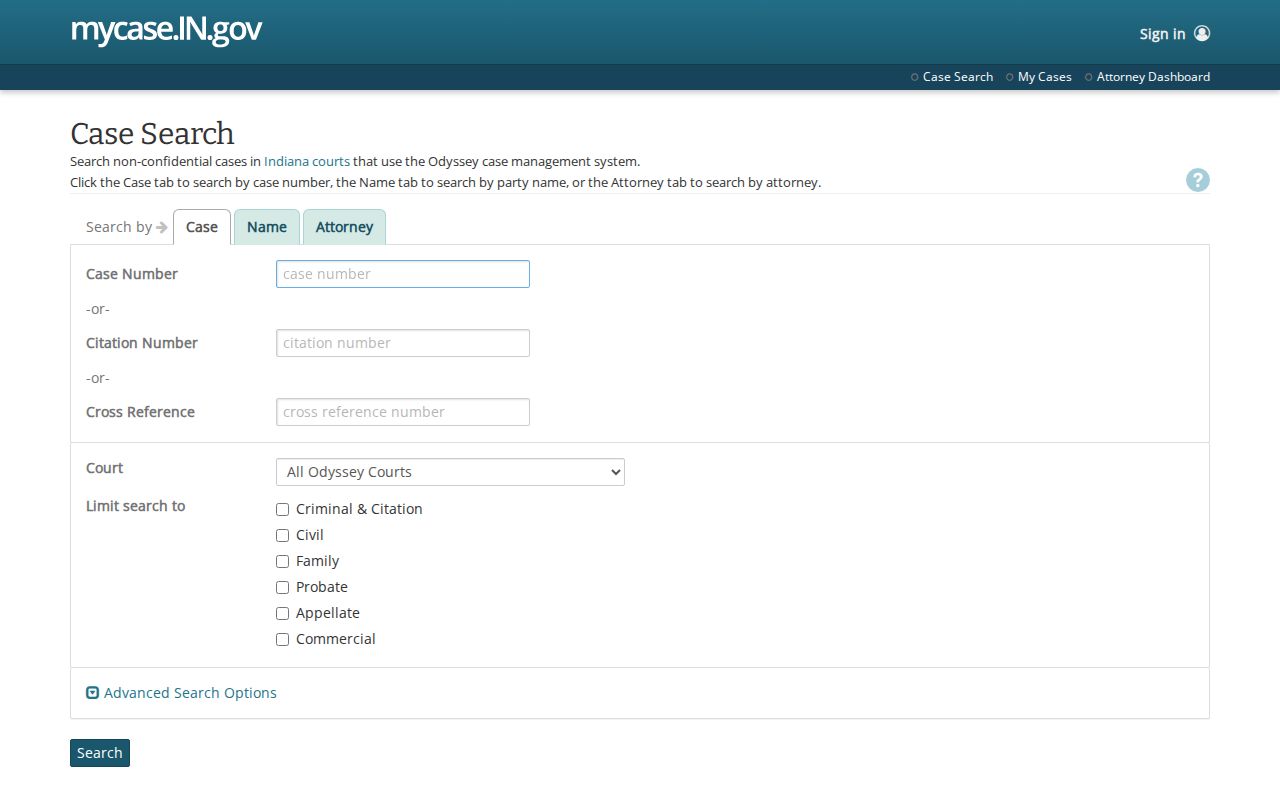
A blank search is not the end. A missed date, a new charge, a sealed matter, or another court could still be involved, so follow up directly with Floyd County officials.
Warrants in Floyd County: The Main Types
One word, several processes. Indiana law splits an arrest warrant built on probable cause apart from a search warrant covering a place or item. Floyd judges can also issue bench warrants after missed court duties. Probation matters can trigger their own court action. In civil contempt, Floyd's local form uses the term body attachment, which is not a criminal warrant.
| Type | How it arises | Issuing authority |
|---|---|---|
| Arrest warrant | A charge backed by judicial probable cause | Floyd Circuit or Superior judge |
| Bench warrant | A missed appearance, contempt, or failed court duty | Judge handling the case |
| Search warrant | Probable cause to search a described target | Authorized judge |
| Traffic-related warrant | Failure to appear or answer in a qualifying case | Usually Superior Court 2, with exceptions |
| Body attachment | Civil contempt procedure | Civil court |
Floyd County courts use plain terms: bench warrant and failure to appear. No Indiana source confirms "capias pro fine" as the local label, so stick with those two when you call the clerk.
Floyd County Courts Route Warrants
The courthouse at 311 Hauss Square houses four trial courts with different jobs. Floyd Circuit Court carries general jurisdiction plus exclusive county probate, trust, and juvenile work. Superior Court 1 hears felony criminal matters along with civil cases. Superior Court 2 is the usual traffic and ordinance court under local rules. Superior Court 3 holds general trial jurisdiction and hosts Veterans Court sessions.
Floyd County Clerk of the Courts
311 Hauss Square, Room 235
New Albany, IN 47150
812-948-5411
Monday through Friday, 8 a.m. to 4 p.m.
Floyd County Sheriff
175 W. Spring Street
New Albany, IN 47150
812-948-5400
Records Requests: 812-542-1790
The Clerk keeps the official court file. The Sheriff handles law-enforcement routing, service, and custody. Neither Floyd County office stands in for the other.
Floyd County Warrant Records: What They Show
Indiana Code spells out what a criminal arrest warrant must contain. A public docket entry may show only part of it. The full court file, or official confirmation, can reveal which Floyd court acted, what charge sits behind the action, and whether a judge set bail. Some details can be sealed, excluded, or redacted.
| Case or warrant identifier | A court-linked number, often tied to a Floyd Odyssey case such as 22D02-YY-XX-#####; this is only a format example. |
|---|---|
| Person | The named or reasonably identified subject; confirm with more than a name. |
| Offense | The charged offense stated in the warrant or case record. |
| Issuing details | The court, date, county, and judicial authorization. |
| Bail | The amount or release direction set by the court, if applicable. |
| Return or status | Service, return, recall, reissue, or another event read in context. |
A status word on a public screen can lag the official file. Before acting, ask the Floyd County Clerk or the issuing court for the current entry.
Negative Floyd County Warrant Results
Floyd County posts no official active-warrant roster. MyCase is a public case portal, and it does not prove that every warrant appears there. A warrant can be newly issued, sealed, tied to a non-public case, held in another jurisdiction, or filed under another name form. Federal matters sit outside Indiana MyCase entirely.
A blank result is not clearance. Confirm a serious personal concern with the Floyd County Clerk, issuing court, or counsel.
The official Sheriff site offers dispatch, records, corrections, and investigation routes rather than a public warrant button for Floyd County.

Use Records Requests for non-exempt records and dispatch for law-enforcement routing. Don't call 911 for a routine Floyd County record check.
Floyd County Warrants: Who Issues, Who Serves
A Floyd County judge issues a warrant after the required legal finding or a qualifying court failure. The Clerk records court activity and provides access to official files. The prosecutor files criminal charges but never replaces the judge's decision. The Sheriff serves process, guards the courthouse, transports prisoners, and runs the jail.
- Issue
- The judge authorizes and signs the warrant.
- Serve
- Law enforcement executes its command.
- Return
- The officer reports the result to the court.
- Recall
- The judge withdraws the warrant by order.
- Reissue
- The court puts a returned warrant back into effect under its rules.
The Sheriff's divisions page documents patrol, corrections, investigations, court security, and transport in Floyd County. No public user can confirm or clear a warrant through it.
Floyd County Warrant Bond Routes
Floyd's local rules make bond a court-controlled decision. During regular hours, a judge or magistrate sets bond and the Clerk handles posting. After hours, on weekends, and on holidays, the jail front lobby accepts the bond types the current order and schedule allow. A judge can change the amount or the terms at any point.
| Bond route | Local meaning |
|---|---|
| Court cash bond | Ten percent of total bond, as the court permits |
| Full cash bond | One hundred percent of the amount |
| Surety bond | Arranged through an approved bonding company |
The jail wants photo ID, exact cash for cash transactions, and a separate $5 Indiana Sheriff's Association death-benefit fee. Confirm the order before you travel. The Floyd jail bond information is posted here.
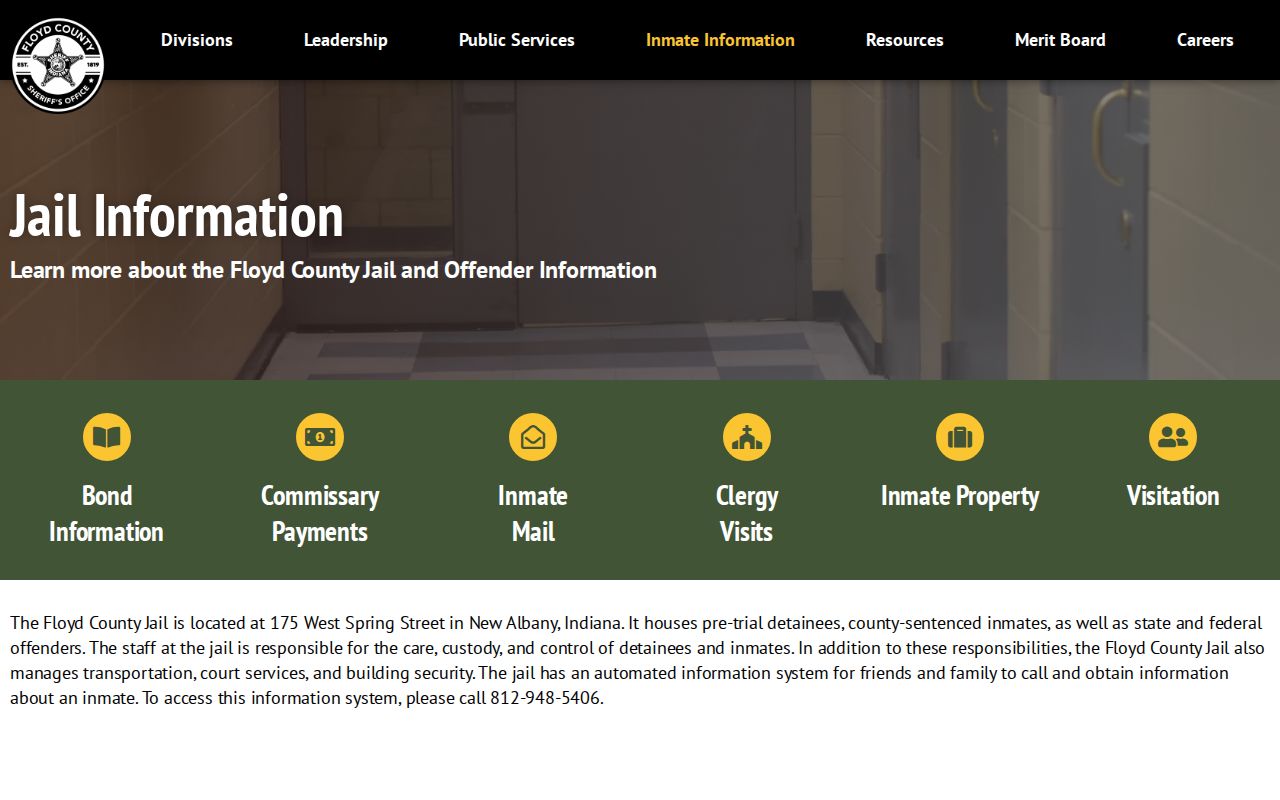
Bond can get a person released in Floyd County. It does not dismiss the case or recall every warrant.
Handling a Floyd County Warrant
Find out which Floyd County court issued the warrant and why. That answer shapes everything after it. Ask the Clerk what the docket currently requires of you, since the next move depends on the order itself. You may need counsel, a hearing request, or a motion to recall. Voluntary surrender or posting the bond the court set are also possible paths, and paying a fine online may not fix a missed hearing or a probation duty.
Plan before appearing. Speak with a lawyer when possible, confirm where to report, and ask the Clerk or jail about timing and bond logistics.
Bring photo ID, the case number, and any notice you received. Hold on to every receipt and filed order, because paper proves what the court did. Then confirm the court entered the outcome in its own records. Only the issuing court can recall a Floyd County warrant, and it will not expire just because time passed or because you left the county.
Floyd County Traffic Warrant Funnel
Local rules steer Floyd County traffic cases down one path. All traffic infractions and ordinance violations land in Superior Court 2. So do most motor-vehicle violations, traffic misdemeanors, and Level 6 felony traffic cases. A few exceptions apply, covering military history, problem-solving court ties, probation, pending cases, and other listed conditions. The Clerk must confirm the actual assignment for any ticket. For payment, Indiana ePay lets you search eligible tickets by UTT number, driver's license number, or name and date of birth. A result can show the police agency, the court, the Odyssey number, the offense, the balance, payment status, and whether it can be paid online. Remember what it is, though: a payment and plea system, not a criminal warrant roster, and no Floyd County warrant list appears there.
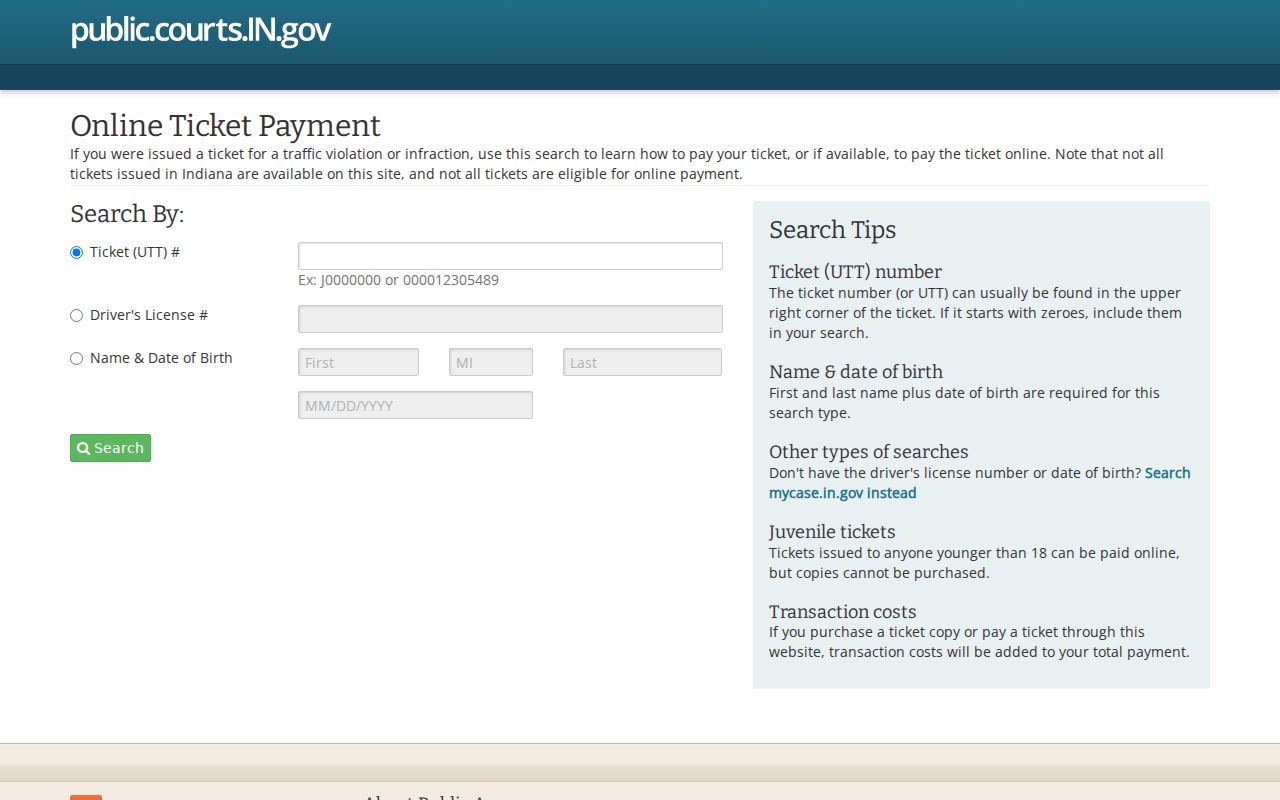
A missing ticket on ePay proves nothing about a Floyd County warrant. Try other search fields and MyCase first, then contact the Clerk if the ticket still will not appear.
Warrant Record Access Under Indiana Law
Indiana treats court records as open by default under its Rules on Access to Court Records. Rule 4 backs your right to inspect accessible court records in Floyd County. Rule 5 carves out defined records and information. Juvenile, sealed, confidential, and sensitive data may stay off any public result.
Key routes:
Indiana court-record requests go to the court or Clerk that keeps the official file.
Indiana Access to Public Records Act governs public-agency requests, exemptions, and responses.
Access Rule 9 supplies a court-order path for some excluded records.
Ask for a focused record and a narrow date range. A lawful denial should name its basis. The Public Access Counselor can sort out qualifying APRA disputes in Floyd County, but it cannot turn an excluded court record into an open one.
Floyd County Public Record Requests
Floyd County policy FCO-2023-36 governs requests to county agencies. Put your identity in writing, describe the record with reasonable particularity, state the format you want, and add contact details. Sheriff Records Requests can route non-exempt law-enforcement material. Court-file requests go to the Clerk under judicial rules.
- Name the record or policy, office, subject, and date range.
- Ask for electronic delivery when that format exists.
- Allow time for search, review, redaction, and installments.
- Request the legal basis for any denial.
Ask for aggregate counts or policy files instead of names, which may serve civic research better. The county may charge lawful fees. Do not ask the Sheriff to reveal sealed Floyd County court content that only a judge can release.
Floyd County Warrant Data Limits
No Floyd County office publishes a current count of active warrants, bench warrants, service rates, or city warrant totals. Jail bookings are not a stand-in. A MyCase result count cannot be read as a warrant count either, since those sources measure different events and may include duplicate, old, sealed, or unrelated cases. Treat any total you see as unverified.
Recent Floyd County rule orders show amendments in 2025 and 2026. That alone proves no amnesty, roundup, portal, or mass clearing program. Before relying on any later notice, check its sponsor, eligibility, dates, and procedure.
City Warrant Records in Floyd County
Floyd County counts three incorporated places. None runs a standalone municipal warrant database. New Albany posts city police contacts, and Georgetown posts a town police contact. Greenville has no local warrant portal or police site, so residents use county routes. In every place, MyCase, the Floyd County Clerk, the court, and the Sheriff form the record chain.
New Albany Warrants
2020 Census: 37,841. City police contacts are separate from Floyd court and jail records.
Georgetown Warrants
2020 Census: 3,805. Town police contact does not create a municipal warrant lookup.
Greenville Warrants
2020 Census: 1,365. Published warrant checks route through county offices.
Floyds Knobs is a Floyd County community but not an incorporated place here. Lanesville sits in Harrison County and is excluded from this list.