
Inside the Floyd County Most Wanted Program
No Floyd County office publishes a most wanted roster. The Floyd County government and the Sheriff do not run one. The Indiana Judicial Branch and Indiana State Police list none. New Albany and Georgetown do not either. What those official sites do offer is practical: agency contacts, court case access, jail and bond facts, police services, and tip channels, so a Floyd County warrant search still starts there.
Verified finding: Floyd County publishes no most wanted roster, no warrant-specific reward amount, and no public update schedule through its official offices.
That gap does not mean Floyd County has no warrants. It only means no official roster exists to copy or treat as a complete list.
No Official Floyd Most-Wanted Roster
A genuine roster names its sponsoring agency. It shows an update date or cadence, a tip channel, safety instructions, and any reward terms. Floyd County's official pages offer no such combination. Without it, there is no sound basis for publishing names, photos, mugshots, or allegations here.
- Most wanted
- A selected agency publicity list, not every active warrant.
- Active warrant
- A warrant the issuing authority currently treats as enforceable.
- Recall
- A court's withdrawal of a warrant.
- Roster cadence
- The stated schedule for reviewing and updating a published list.
A third-party Floyd County list can be stale, mix jurisdictions, miss a recall, or flag the wrong person. Official confirmation is essential.
How Floyd County Most Wanted Lists Work
A most wanted list is a curated subset. Selection may reflect an ongoing investigation or a public request for tips. It is not Floyd County's full warrant inventory. Updates matter as well, because service, recall, bond, or court action can change a warrant's status quickly.
| Sponsor | The named Sheriff, police agency, or Crime Stoppers partner responsible for publication. |
|---|---|
| Update date | Evidence that the record has been reviewed recently. |
| Tip route | The official telephone or form linked by the sponsor. |
| Safety notice | Direction not to intervene and to use emergency services when needed. |
| Reward terms | Eligibility and amount stated by the official program, if any. |
Do not guess those details for Floyd County. Check any future notice against the publishing agency's own page.
Floyd Sheriff Tip Line Limits
The Floyd County Sheriff lists 812-945-3273 as an anonymous drug-tip line. That number is not a most wanted tip line. The Sheriff sets out no warrant reward amount or payment policy. Calling it a paid fugitive-tip service would be wrong. In an emergency, dial 911. General dispatch and non-emergency routing is 812-948-5400, Sheriff Records Requests is 812-542-1790, and each number has its own role. None of them authorizes you to confront, follow, or detain anyone.
Sending a Most Wanted Tip Safely
Floyd County runs no most wanted program, so start with the nature of your concern. Immediate danger goes to 911. A non-emergency law-enforcement matter goes to Sheriff dispatch, and a drug tip fits the line kept for that purpose. A question about court records belongs with the Clerk.
- Do not approach or attempt to detain anyone.
- Use 911 when there is an immediate threat or emergency.
- Give dispatch only facts personally observed.
- Do not post names, locations, or images online.
- For warrant status, use the issuing court and Clerk instead of a tip line.
Safety: Never turn an online photo or rumor into personal intervention; contact the proper official channel and step away.
Floyd Court Record, Not Wanted Search
Indiana MyCase searches public court records in Floyd County, covering Floyd Circuit Court and Superior Courts 1, 2, and 3. It shows case numbers, courts, filings, hearings, and docket events. But it is not a live wanted database. The Indiana Judicial Branch also states plainly that MyCase is not the official record.
| Need | Channel | Limit |
|---|---|---|
| Public case history | MyCase | May be incomplete or restricted |
| Official court file | Floyd County Clerk, 812-948-5411 | Access rules apply |
| Sheriff-held record | Records Requests, 812-542-1790 | No promise of a created roster |
| Custody or bond | Jail/AIS, 812-948-5406 | Not a case disposition source |
A blank MyCase search proves little. A sealed, restricted, brand-new, or badly searched Floyd County record can still hide a case, so call the clerk who keeps the record.
How Most Wanted Differs From an Active Warrant
A most wanted label is a publicity choice. An active warrant is a legal status. Someone in Floyd County can hold an active warrant yet appear on no public list, and an old online image can linger long after a status changes.
| Point | Most-wanted roster | Active warrant |
|---|---|---|
| Scope | Selected people publicized by an agency | All enforceable warrants held by authorities |
| Public availability | Only if an agency publishes it | May not be available as a public list |
| Status source | Publishing agency | Issuing court and law enforcement |
| Floyd finding | No official roster located | Confirm individual status officially |
No official count of active Floyd County warrants exists either. Jail bookings and MyCase result totals cannot be turned into a trustworthy number.
Floyd Hearing Reminders Are Not Amnesty
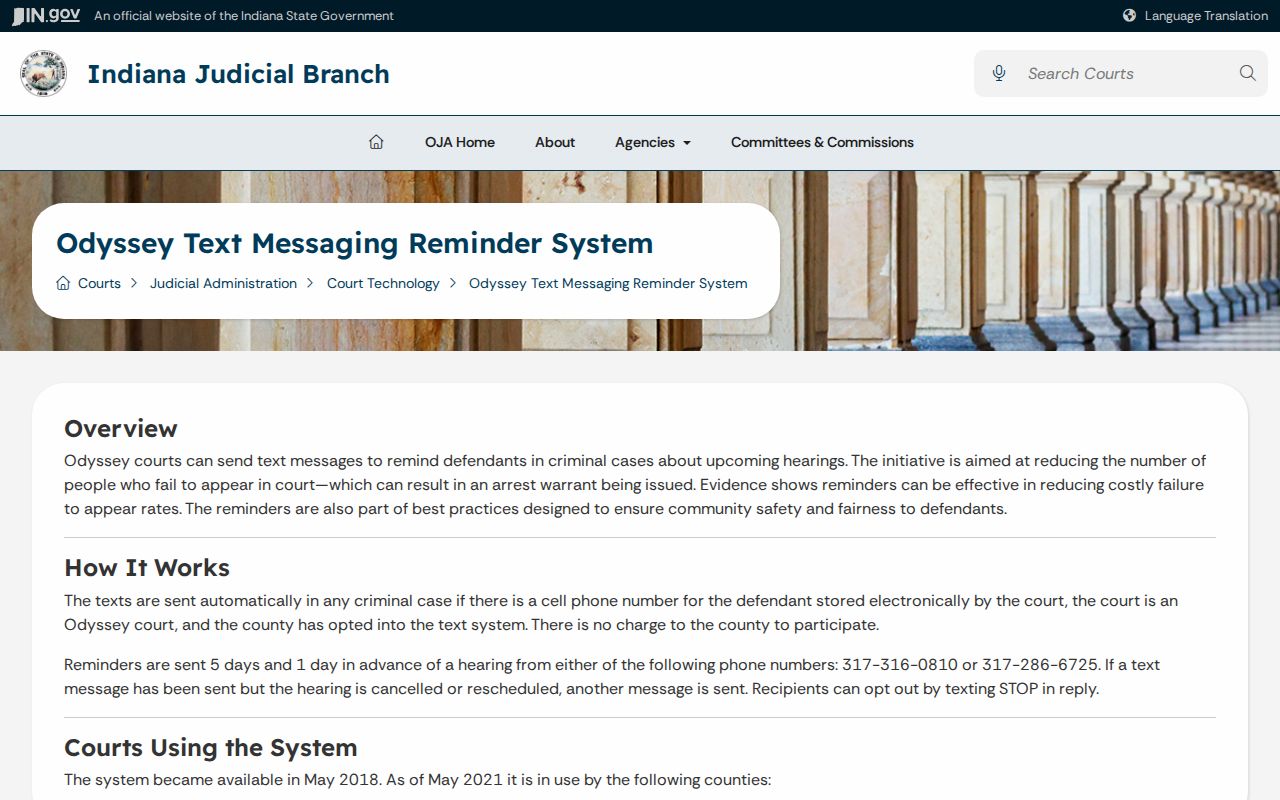
Indiana offers an Odyssey text-message reminder program meant to reduce missed hearings, though no Floyd County participation is listed. It is not amnesty. A reminder is not a warrant recall or a promise of waived penalties. The state hearing-reminder source explains the statewide program.
If a Floyd County roundup or amnesty announcement ever surfaces, verify it with the named court or Sheriff. Dates matter. So do eligibility rules and any required action.
Floyd Tax Warrants Are Different
Indiana's tax-warrant system concerns tax debt. It is not a Floyd County criminal lookup. Nor is it a most wanted roster, and the Indiana tax-warrant source documents that separate system, because similar words do not make the records interchangeable.
A tax-warrant search result in Floyd County is not proof of a criminal warrant or fugitive status.
Federal Task Forces Are Not Floyd Lists
The Great Lakes Regional Fugitive Task Force works a regional federal mission. The U.S. Marshals Southern District of Indiana covers Floyd County. Neither one creates a county most wanted roster. Federal cases appear in PACER and the Southern District Clerk rather than county channels, and sealed matters stay beyond an ordinary public search. The New Albany federal Clerk sits at 121 W. Spring Street and lists 812-542-4510. The Marshals office there is an official federal law-enforcement route. It is not a Floyd County name-search portal. MyCase leaves federal cases out entirely.
When You Believe You Are Listed
Found a name that looks like yours on a most-wanted page? Do not act on that alone. Search your own case in MyCase, note the court code and cause number, and then call the Floyd County Clerk or the issuing court. Ask if a warrant is active and what hearing, motion, surrender, or bond step fits your situation.
- Save the official case reference, not a social-media screenshot.
- Confirm status with the issuing court.
- Consult a lawyer about safe resolution.
- Ask for reporting and bond instructions before travel.
- Keep proof of all court action and verify the later docket entry.
Helping a relative? Hand over the official Floyd County contact and push them toward counsel. Never confront the person, post claims, or play law enforcement. Bond may free them, but the case itself goes on.
Floyd Most Wanted Status Changes
Floyd Local Rule LR22-CR00-211 is why current confirmation matters so much. It allows certain misdemeanor warrants to be returned after six months. Felony and bench warrants can come back after one year, with reissue as applicable. That return is an administrative step, though, not an automatic expiration. So an old most-wanted list can miss a return, reissue, service, or recall. Only the issuing court can say what the docket means today. In Floyd County, the Clerk in Room 235 keeps the court record and runs the listed bond route during regular hours. The jail at 175 W. Spring Street answers custody questions and handles the after-hours bond process. Two buildings, two different jobs, and they sit close together. Call first to learn where to go, what identification to bring, whether bond has been set, and whether counsel should arrange the appearance.