
How Arrest Warrants Work in Floyd County
Indiana Code 35-33-2-1 lays out the path. After an indictment, a Floyd County judge may sign an arrest warrant on that basis alone. Charges filed by information work differently. There the judge must first decide that probable cause exists, meaning a reasonable, fact-supported belief that an offense happened and that the named person committed it. Once signed, the written order authorizes an arrest and prompt presentation before the court. Floyd County runs four courts of record: Floyd Circuit Court plus Superior Courts 1, 2, and 3, with assignment turning on the charge and any related proceedings. A public Indiana MyCase entry can point you to the right case and court, though MyCase is not the official record. The Floyd County Clerk confirms what is actually in the file.
Floyd Arrest Warrant Probable Cause
Behind every warrant request sits a probable-cause affidavit laying out the asserted facts for the judge. Floyd County readers should know that Indiana Code 35-33-5-2 splits those facts into two kinds: what the affiant knows personally, and what comes in as hearsay. Hearsay works only if the affidavit gives a basis for its credibility or reliability, or the information gets corroborated.
- Affidavit
- A written statement sworn to be true.
- Information
- A formal charge filed by the prosecutor.
- Probable cause
- The legal threshold for issuance, not proof beyond a reasonable doubt.
- Return
- The officer's record showing how process was handled.
Not everything surfaces. Some affidavit or investigation details in a Floyd County file may be sealed, redacted, or excluded, and juvenile records face added limits. An affidavit missing online does not erase the case or prove that no Floyd County arrest warrant exists.
Arrest Warrants: What They Contain
Indiana Code 35-33-2-2 spells out what a warrant must contain. Beyond that core, a Floyd County court file may hold charging papers, docket events, bond activity, service information, and a later recall or disposition. Exact contents vary with the case and the access rules that apply.
| Person | The named person or a description that reasonably identifies that person. |
|---|---|
| Offense | The nature of the alleged offense. |
| Issue details | The date, county, and issuing official's signature and title. |
| Command | Direction to arrest and bring the person before court without needless delay. |
| Bail | The amount stated in the warrant or later controlled by court. |
| Court identifier | A cause number may include 22C01, 22D01, 22D02, or 22D03. |
Read a Floyd County docket in sequence, not in snippets. Issuance may be followed by service, bond, an appearance, a recall, or a disposition, so one isolated entry cannot establish current status.
Floyd Arrest Warrants Are Not Convictions
A Floyd County arrest warrant is an order. It records a court's authority to take a person into custody, nothing more. The indictment or information is what starts a criminal case, and the process that follows determines the outcome. A docket note of "probable cause found" marks only the issuance threshold.
Key point: Read the whole Floyd County docket and verify current status with the Clerk before acting on an old warrant entry.
A stale or unofficial warrant list can miss a recall or mix up two people who share a name. For an active Floyd County warrant, only direct confirmation from the issuing court protects accuracy.
How Warrants Get Served in Floyd County
The Floyd County Sheriff divisions cover patrol, corrections, investigations, courthouse security, and prisoner transport. As an officer of the courts, the Sheriff may execute process or hold a person after arrest. City police and other authorized officers can also encounter a valid warrant and execute it. Service may happen through direct contact, at a traffic stop, or during another lawful encounter. From there, expect booking, prompt court presentation, and a bond decision. The jail handles custody and after-hours bond logistics, but it does not replace the issuing court's record; the Floyd County Clerk, judge, prosecutor, and Sheriff each play a separate role.
Floyd Arrest Warrant Record Routes
For a court-file question in Floyd County, call or visit the Clerk in Room 235 at 311 Hauss Square, New Albany, 812-948-5411, Monday through Friday, 8 a.m. to 4 p.m. Bring what you have. The cause number, court code, known hearing date, and current contact information all speed the request.
| Need | Official channel |
|---|---|
| Case events or status | MyCase, then Clerk or issuing court |
| Sheriff-held record | Records Requests, 812-542-1790 |
| Custody or bond logistics | Jail/AIS, 812-948-5406 |
| Emergency | 911 |
Floyd County publishes no official public arrest-warrant roster. A records request cannot force the Sheriff to build an informal list the office does not keep.
Arrest Warrants, Summonses, and Bench Warrants
These terms do different jobs. A summons directs a Floyd County appearance without first authorizing custody, while an arrest warrant rests on probable cause tied to an alleged offense. A bench warrant typically follows a failure to appear, contempt, or a probation matter.
| Feature | Arrest warrant | Summons | Bench warrant |
|---|---|---|---|
| Main command | Take into custody | Appear on a date | Bring before court |
| Typical basis | Probable cause | Charge handled by appearance | Unmet court duty |
| Response | Confirm, counsel, surrender and bond plan | Appear as directed | Ask about recall, hearing, or surrender |
A traffic citation is not a Floyd County arrest warrant. It carries its own identifier. Missing the court date, though, can create a separate failure-to-appear event.
Federal Floyd Arrest Warrant Route
Federal cases never show up in Floyd County MyCase. The Southern District of Indiana's New Albany Division sits at 121 W. Spring Street. Its Clerk's Office, Room 210, answers at 812-542-4510. PACER is the public federal docket route, though sealed matters will not appear there. The assigned New Albany federal courthouse source lays out that access point.
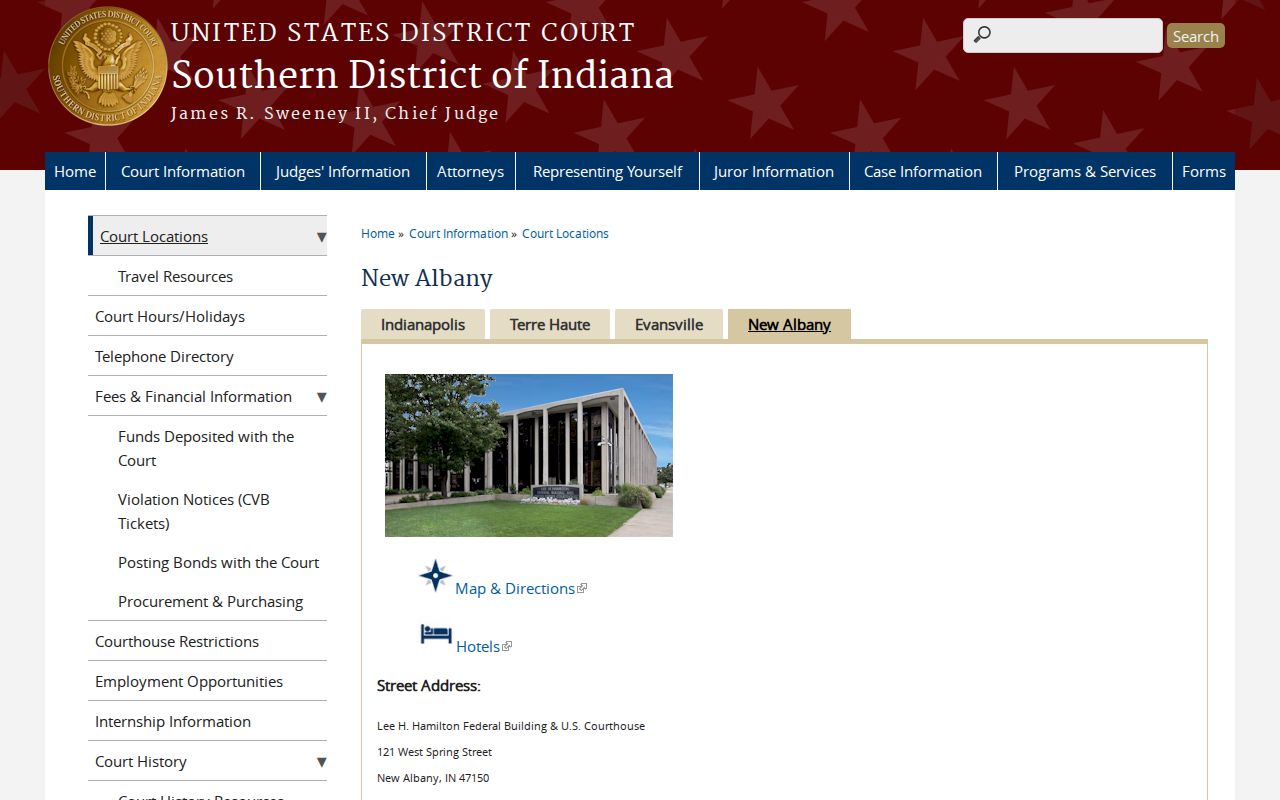
This federal Clerk route stands apart from the Floyd County Clerk and Sheriff. The Great Lakes Regional Fugitive Task Force source documents a regional federal mission.
It offers no Floyd County public roster. The New Albany Marshals office is a law-enforcement route, not a public name-search service.
Floyd Arrest Warrant Status Changes
A Floyd County warrant record is not frozen in time. Officers can execute it. The court may set a hearing, adjust bond, or withdraw the order entirely through a recall or quash. Recall pulls the warrant back. Quash strips it of legal force. Neither ends every fee or duty tied to the case, so check with the court before assuming anything is settled.
Floyd County also has an administrative rule worth knowing. Local Rule LR22-CR00-211 returns certain misdemeanor warrants to the issuing court after six months, while felony and bench warrants return after one year and may be reissued. That cycle is bookkeeping, not forgiveness. No Floyd County arrest warrant simply expires under this rule, and the underlying charge stays in place. The issuing court is the only office that can tell you the current status of the order, so call it directly rather than guessing from a docket entry.
Handling an Arrest Warrant in Your Name
Start with the case number and court code in MyCase. Then call the issuing court or the Floyd County Clerk. Ask three things: is the warrant active, is bail set, and is the next move a hearing, a filing, or a planned surrender? An online payment alone does not recall it.
- Confirm the record with the issuing court.
- Ask a lawyer about the charge, surrender, and any motion to recall or quash.
- Ask where to report and what identification is required.
- Confirm bond type and payment before travel.
- Keep proof of each filing, payment, appearance, and release.
Posting bond in Floyd County follows a set route. During Clerk hours, bond instructions go through Room 235. After hours, on weekends, and on holidays, the jail front lobby handles them instead. The math is fixed: court cash means 10 percent of the total, full cash means 100 percent, and surety comes through an approved company. Bring exact cash and valid ID. Getting out on bond releases you under the order, but the case itself goes on.
Important: Contact counsel before surrendering; an active warrant may lead to arrest during any lawful police contact.